

“Accepting I had Parkinson’s took years, but it’s what finally helped me move forward”
A lot can happen in 10 years. For Steve Norman, it’s seen him embrace exciting hobbies, excel in a new job, help countless individuals going through challenging times and enjoy quality time with his family and friends.
It’s also seen him come to terms with a Parkinson’s disease diagnosis.
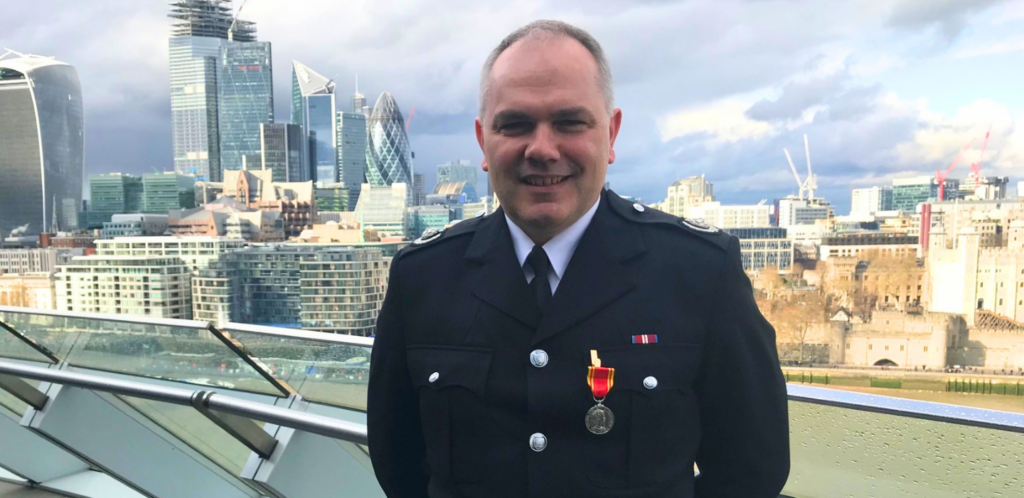
Steve, who’s former Deputy Assistant Commissioner for London Fire Brigade and now works for the National Fire Chiefs Council (NFCC), is sharing his story for Parkinson’s Awareness Month to highlight not just the condition, but the power of acceptance – and the support available along the way.
“I started off as a firefighter in 1998 and did 25 years with London Fire Brigade, finishing as Deputy Assistant Commissioner,” says Steve. “I absolutely loved it.”
During those years, he and his family were regular visitors to Harcombe House, our centre in Devon, for rental breaks: “We went for about 19 years. The kids got so used to going there that they were completely comfortable within five minutes of arriving!”

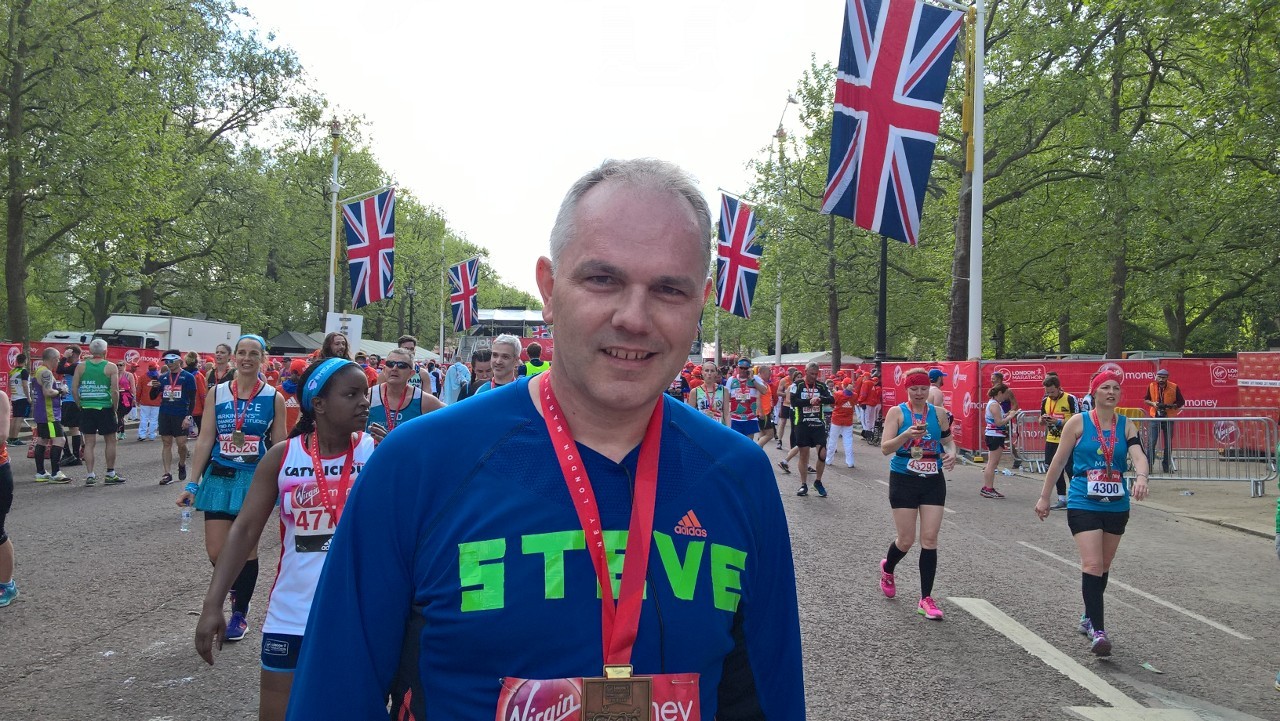
Alongside his work, he enjoyed a very active lifestyle, having run marathons and played racket sports for years. So, when he started noticing changes in his right arm in his late forties, he initially assumed it was an injury.
“I had about three years of knowing something wasn’t quite right,” says Steve. “I started to get pins and needles in my little finger and index finger on my right hand, then I stopped swinging my arms as much when I walked. I had loads of acupuncture, physiotherapy, you name it to try and resolve it, but nothing seemed to work.”
Steve visited a GP several times before being seen by a specialist, who carried out a DaT scan, which confirmed he wasn’t producing enough dopamine – a clear sign of Parkinson’s. He was just 49 years old at the time.
The disease had never crossed his mind, but his family had begun to put the pieces together: “They’d already worked it out,” Steve says. “My daughter was only 14 or 15 at the time, and she’s actually since become a doctor.”
At first, Steve says the diagnosis didn’t feel real. He carried on as he had before and felt little change in terms of fatigue which may have been masked by having always worked long hours and night shifts. Eventually, however, the symptoms became harder to ignore.
“About three years after I was diagnosed, a friend asked me: ‘have you accepted that you’ve got Parkinson’s disease?’ I realised I hadn’t. I was still trying to be a 40-year-old, rather than my 49-year-old diagnosed with Parkinson’s self. It’s only once you accept it that you can move forward with how you’re going to live your life, instead of trying to do what you’ve always done.”
Once he began speaking openly, colleagues made small adjustments at work to help him – and Steve made his own at home.
“I know it’s not the case for everyone but personally, I would describe Parkinson’s as a frustration more than a disability,” he says. “You just have to find different ways of doing things.
“If you work on your flexibility, have a good diet, try and find ways of sleeping – which can be difficult – and do all the things you’d be doing anyway to maintain a healthy lifestyle, then you’ll find Parkinson’s a whole lot easier.
“I used to play a lot of tennis and badminton but began to struggle with the grip in my hand. Having let go of my racket a couple of times I discovered padel – there’s wrist straps, it’s a more compact game and it means I’m still getting the enjoyment out of it.”
“The charity is always there for us – and it could be there for you too”
Steve Norman
Steve chose to retire from LFB around this time too, but has since gone on to work across everything from building safety to protecting vulnerable people through his work for the NFCC.
He also visited Harcombe House for a rehabilitation stay, experiencing the care and support available to the fire services community first-hand.
While Steve is now unable to write, advances in technology have meant it hasn’t impacted his work as he can use dictation and accessibility tools.
“It’s a bit like a lot of neurological conditions, you can be fine one day and completely different the next,” he says. “Understanding from family, friends and colleagues has been vital.”
He now plans his days out more thoroughly, allowing more time either side as well as planning out travel, and scoping out practical things like toilet access in advance.
“The support from my colleagues has provided a lot of benchmarks too,” he adds. “I see them less than my family, so they’re able to recognise changes in me.”
Steve is now encouraging anyone with a similar diagnosis to explore the support around them – including what’s available through Fire Fighters Charity.
“I’ve got a neuro physiotherapist privately who’s done amazing work with me,” he says. “The charity is always there for us too. Just having the breaks away for all those years was fantastic for my family – and it could be there for you too.”
If you feel you’d benefit from our health and wellbeing support, you can call our Support Line on 0800 389 8820, make an enquiry online or click below: